Poland's Residential Market in 2026: Warsaw, Kraków, Wrocław and Katowice Are Entering Different Phases of the Cycle
Poland's housing market is recovering, but there is no longer one national story. Transaction data shows Warsaw stabilising, Kraków regaining pricing momentum, Wrocław combining stronger demand with a still negotiable development pipeline, and Katowice offering the lowest entry prices — at the cost of markedly weaker liquidity.
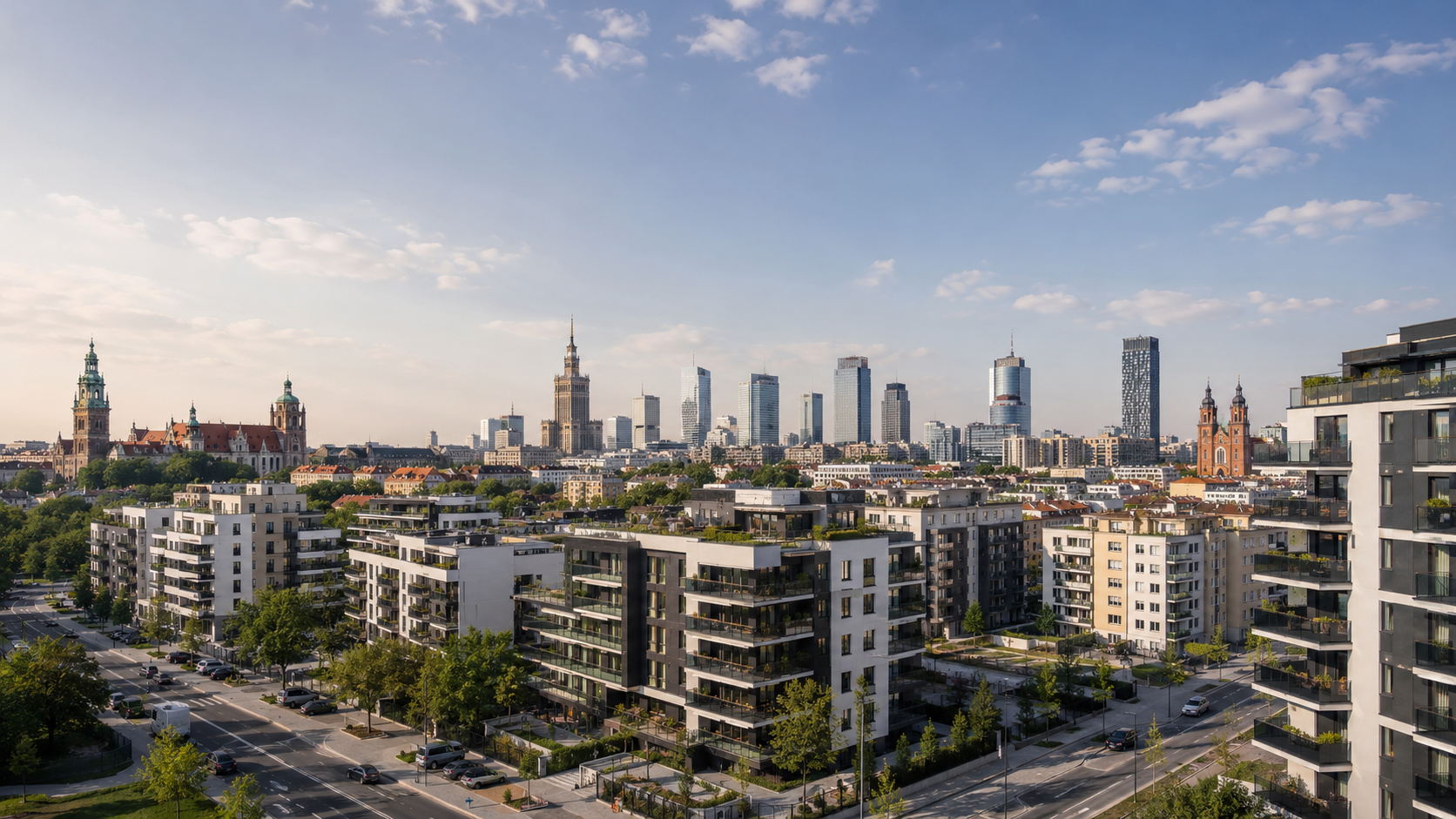
For much of 2025, the Polish residential market was described in deceptively simple terms: demand had weakened, developers were sitting on record inventories and the extraordinary price growth of the previous two years had finally run out of momentum.
By mid-2026, that description is becoming outdated.
Mortgage demand is rebuilding, developers are becoming more disciplined with new launches, and sales are once again beginning to absorb the stock accumulated during the previous slowdown. Yet the recovery is anything but uniform. Warsaw, Kraków, Wrocław and Katowice are now behaving like four increasingly distinct residential markets.
That distinction matters for investors.
The spread between asking and achieved prices remains material. Liquidity varies sharply from one city to another. Developers are still discounting selected units, even while transaction volumes improve. And in some locations the premium commanded by new-build apartments over the secondary market has become difficult to ignore.
The most useful starting point is therefore not the price displayed in an online listing, but the price recorded when a transaction actually closes.
Transaction prices tell a more restrained story
Data compiled by Deweloperuch from Poland's Rejestr Cen Nieruchomości, the official property price register based on notarial transactions, provides a useful counterweight to listing portals. Its methodology is particularly relevant because advertised prices can diverge substantially from the levels ultimately accepted by buyers and sellers. Deweloperuch notes that RCN data is generally reported with a delay and that its nationwide comparison statistics rely on secondary-market transactions.
In the fourth quarter of 2025, the median transaction price stood at PLN 16,413 per sq m in Warsaw, PLN 14,606 in Kraków, PLN 12,437 in Wrocław and just PLN 8,004 in Katowice.
The year-on-year direction was just as important as the absolute price.
Warsaw was down 2.9%, Kraków 1.9% and Wrocław 0.7%. Katowice, by contrast, recorded a 2.2% increase.
Those figures captured the end of the correction phase. Data available during the summer of 2026 suggests that the next stage of the cycle is becoming considerably more differentiated.
| City | Latest available RCN median | YoY change | Current new-build asking price | Active developer offers |
|---|---|---|---|---|
| Warsaw | PLN 16,196/sq m | -1.6% | PLN 18,115/sq m | 13,156 |
| Kraków | PLN 15,103/sq m | +3.7% | PLN 16,657/sq m | 7,932 |
| Wrocław | PLN 12,922/sq m | +4.2% | PLN 15,015/sq m | 5,620 |
| Katowice | PLN 8,361/sq m | +2.0% | PLN 12,872/sq m | 3,669 |
The reporting periods are not identical: the latest RCN observation available for Warsaw is March 2026, Wrocław April, while Kraków and Katowice already have July data. The numbers should therefore not be treated as a same-month ranking. They are more useful as evidence of the direction each local market is taking.
Mortgage demand is returning
The change in sentiment is not limited to property databases.
Poland's Credit Information Bureau, BIK, reported that the value of mortgage enquiries in July 2026 was 22% higher than a year earlier. The number of applicants increased by 11.6% year on year, while the average requested mortgage reached PLN 538,500, 9.3% above the July 2025 level.
Actual mortgage lending is rising even faster. In July, the number of housing loans granted was 33.1% higher year on year, while their value increased by 45.3%. Across January to July 2026, the value of new housing lending was 57.2% higher than in the corresponding period of 2025.
This matters because Poland remains a market in which financing conditions have a direct and visible influence on residential absorption. Improving mortgage availability does not guarantee another rapid price cycle, but it does widen the pool of buyers able to transact.
At the same time, developers are becoming more cautious.
Otodom estimates that more than 4,400 new homes were sold across Poland's seven largest residential markets in July, almost 12% more than a year earlier. Developers added only around 3,000 new units. During the first seven months of 2026, sales were already 15% higher than new supply. A year earlier the relationship was reversed: launches exceeded sales by 33%.
The market is therefore no longer accumulating inventory at the pace seen in 2025.
But what happens next depends heavily on the city.
Warsaw: liquidity remains its greatest asset
Warsaw continues to be Poland's most expensive and deepest residential market.
The latest RCN data shows a median transaction price of PLN 16,196 per sq m in March 2026, 1.6% below the corresponding month a year earlier. The median apartment sold for PLN 750,000. Yet transaction volumes remain substantial: 3,150 secondary-market transactions were recorded in the first quarter, 1.4% more than a year earlier.
That combination is important. Prices have softened without triggering a collapse in market activity.
The largest transaction bracket in Warsaw remains PLN 600,000–800,000, accounting for more than 29% of first-quarter deals. Transactions between PLN 800,000 and PLN 1 million increased by 6.3% year on year.
For an investor, this is what makes Warsaw different from smaller Polish markets. The entry price is high, but the buyer pool at exit is correspondingly deeper.
The primary market remains expensive. Deweloperuch currently tracks 13,156 active developer offers at an average PLN 18,115 per sq m, with 2,601 units priced below their original launch level.
NBP data reinforces the distinction between headline pricing and achieved pricing. In Q2 2026, the average primary-market asking price in Warsaw was PLN 18,488 per sq m, compared with a transaction price of PLN 16,783. The asking price therefore stood roughly 10% above the achieved transaction level when measured against the transaction price.
This does not imply that buyers can routinely negotiate a 10% discount on an individual apartment. The mix of properties offered and sold is different. It does, however, show why asking prices should not be treated as fair value.
Warsaw in 2026 looks less like a momentum market and more like a capital-preservation market: expensive, selective and comparatively liquid.
Kraków: pricing momentum has returned
Kraków is sending a different signal.
At the end of 2025 its median secondary-market price was still down year on year. By July 2026, the RCN median had reached PLN 15,103 per sq m, an increase of 3.7% year on year. The median apartment transaction was PLN 700,000.
Volumes are moving in the same direction. Second-quarter transactions reached 1,598, up 2.5% year on year and 6.7% from the previous quarter.
More tellingly, demand is not restricted to the lowest price brackets. Transactions between PLN 800,000 and PLN 1 million increased by 9% year on year, while deals between PLN 1 million and PLN 1.5 million rose by more than 16%.
That is a healthier signal than price growth generated solely by small, entry-level apartments.
On the primary market, Deweloperuch currently monitors 7,932 active units at an average PLN 16,657 per sq m. Around 2,662 are priced below their original starting level. Yet some projects have recently begun moving prices upward again — an indication that developers are testing whether pricing power has returned.
NBP data shows a primary-market transaction price of PLN 15,923 per sq m in Q2 2026, up 3.5% quarter on quarter. The equivalent asking price was PLN 16,867.
Kraków may therefore be the clearest of the four cities where a 2025 correction is transitioning back into measured price growth.
The risk is obvious: once buyers recognise the same trend, the best entry window may narrow quickly.
Wrocław: perhaps the most interesting point in the cycle
Wrocław presents a more complex — and potentially more attractive — picture.
The latest RCN median reached PLN 12,922 per sq m in April, 4.2% higher than a year earlier. First-quarter transaction volumes rose by 17.5% year on year to 1,468 deals.
But the underlying segments remain mixed. Apartments below 35 sq m were still 0.7% cheaper year on year in Q1, while the 35–60 sq m segment declined 0.6%. Larger apartments between 60 and 90 sq m increased by 3.3%.
In other words, the headline median is recovering faster than some of the most liquid apartment categories.
That is precisely what makes the current phase interesting.
Deweloperuch tracks 5,620 active new-build units at an average asking price of PLN 15,015 per sq m, with 1,700 below their original launch price. Individual units in projects such as Sudea have recently recorded price reductions exceeding PLN 90,000 or even PLN 100,000.
Meanwhile, Otodom reported exceptionally strong sales in Wrocław during July, while new introductions were unusually limited.
NBP puts the Q2 primary-market transaction price at PLN 14,312 per sq m, against an asking level of PLN 15,575. Importantly, the transaction price was still 4.7% lower than a year earlier despite rising 2.9% quarter on quarter.
That combination deserves attention: recovering transaction activity, weaker new supply, and developers still carrying discounted inventory.
For buyers with patience and strong negotiating discipline, Wrocław may currently offer the most balanced risk-reward profile of the four markets.
Katowice: attractive pricing, but liquidity cannot be ignored
Katowice is the cheapest market in the comparison by a considerable margin.
The July RCN median was PLN 8,361 per sq m, up 2% year on year, with a median total transaction value of just PLN 390,000.
At first glance, that makes the city appear inexpensive relative to Warsaw, Kraków and Wrocław.
The problem is liquidity.
Only 620 transactions were recorded in the second quarter, down 40.3% year on year and 29.5% from the previous quarter. The largest price band was PLN 300,000–400,000, representing 27.7% of transactions. Another 20.5% fell between PLN 400,000 and PLN 500,000.
This is a market where total ticket price matters enormously.
It is also a city where the difference between new and existing housing has become unusually wide.
NBP data for Q2 2026 puts the primary-market transaction price at PLN 11,840 per sq m, compared with only PLN 8,102 per sq m on the secondary market — a 46.1% premium for new housing.
That spread should make investors cautious about paying a "new-build premium" without a strong location or product rationale.
Current developer inventory remains substantial. Deweloperuch monitors 3,669 active primary-market units with an average asking price of PLN 12,872 per sq m. As many as 1,354 are below their initial launch price — approximately 37% of the monitored stock. Recent recorded price cuts in individual Katowice projects run into tens of thousands of złoty.
There is, however, a counterargument.
Construction starts are falling sharply. GUS data aggregated by Deweloperuch shows 2,468 residential starts in Katowice over the latest 12-month period, down 34% year on year. If developers continue to hold back new launches, the current excess inventory can gradually be absorbed.
Katowice is therefore not necessarily a weak investment market. It is a market where the acquisition price matters more than the headline growth rate.
Buying at the developer's asking price and buying at a genuinely discounted clearing price are two very different propositions.
The asking-price illusion
Across all four cities, one lesson stands out: asking prices continue to overstate where much of the market actually clears.
In Q2 2026, NBP primary-market data showed asking prices above transaction levels in every city analysed. The premium of asking over achieved transaction prices was approximately 10.2% in Warsaw, 5.9% in Kraków, 8.8% in Wrocław and 7.3% in Katowice when calculated relative to the transaction price.
The figures should not be interpreted as a universal negotiation discount. They are market-level averages affected by the composition of available and sold stock.
But for underwriting purposes they are highly relevant.
An investor modelling returns from portal asking prices rather than transaction evidence may be starting from the wrong valuation benchmark.
Four cities, four investment cases
The Polish residential market is no longer moving as a single trade.
Warsaw is primarily a liquidity and capital-preservation story. Entry prices are highest, but so is market depth. The current phase looks more like consolidation than distress.
Kraków has the strongest visible pricing momentum. Transaction values and volumes are improving simultaneously, suggesting that the market has moved beyond simple stabilisation.
Wrocław may offer the most attractive tactical entry point. Demand is recovering, new supply has moderated and significant discounts remain visible within existing developer inventory.
Katowice offers the lowest cost base and potentially the greatest negotiating leverage, but also the greatest liquidity risk. Investors need to be especially disciplined about micro-location, purchase price and exit assumptions.
The national backdrop is becoming more supportive. Mortgage demand has recovered, developers are launching fewer units, and housing sales are once again outpacing additions to supply.
That does not mean Poland is returning to the indiscriminate residential boom seen earlier in the decade.
The more likely scenario is a selective market in which performance increasingly depends on the city, district, unit size and — above all — acquisition price.
For investors, that may be a healthier market.
The easy trade was buying into broad price inflation.
The next one will require buying the right apartment, in the right submarket, at a price that can be defended against actual transactions rather than advertised expectations.