Trump International Hotel & Resort Maldives: DarGlobal Brings the Trump Brand to Noonu Atoll
Institutional-grade analysis of DarGlobal's first Trump-branded resort in the Maldives: verified facts, developer financials, market context and an honest assessment of what has not yet been disclosed.
DEVELOPER SPOTLIGHT
Property News Insights Research | Institutional Edition
Executive Summary
The announcement of Trump International Hotel & Resort Maldives marks one of the most high-profile branded resort launches in the Indian Ocean in recent years. Developed by DarGlobal PLC, a London Stock Exchange-listed luxury real estate developer, the project introduces the Trump hospitality brand to the Maldives for the first time through a fully integrated luxury resort and branded residences development.
Unlike many luxury resort launches that rely primarily on architectural renderings and lifestyle marketing, this report evaluates the project from an institutional investment perspective. The objective is not to assess whether the development is visually attractive, but whether it demonstrates the characteristics expected of an institutional-grade hospitality real estate investment.
At the time of publication, DarGlobal has confirmed the overall concept of the project, its location, development partner and several key technical parameters. However, many of the commercial assumptions typically required for investment underwriting—including projected rental income, operating margins, service charges, owner returns and hotel operating agreements—have not yet been publicly disclosed.
For this reason, this report intentionally distinguishes between verified information obtained from public sources and information that has not yet been released by the developer. No financial forecasts are presented unless supported by publicly available documentation.
Project Overview
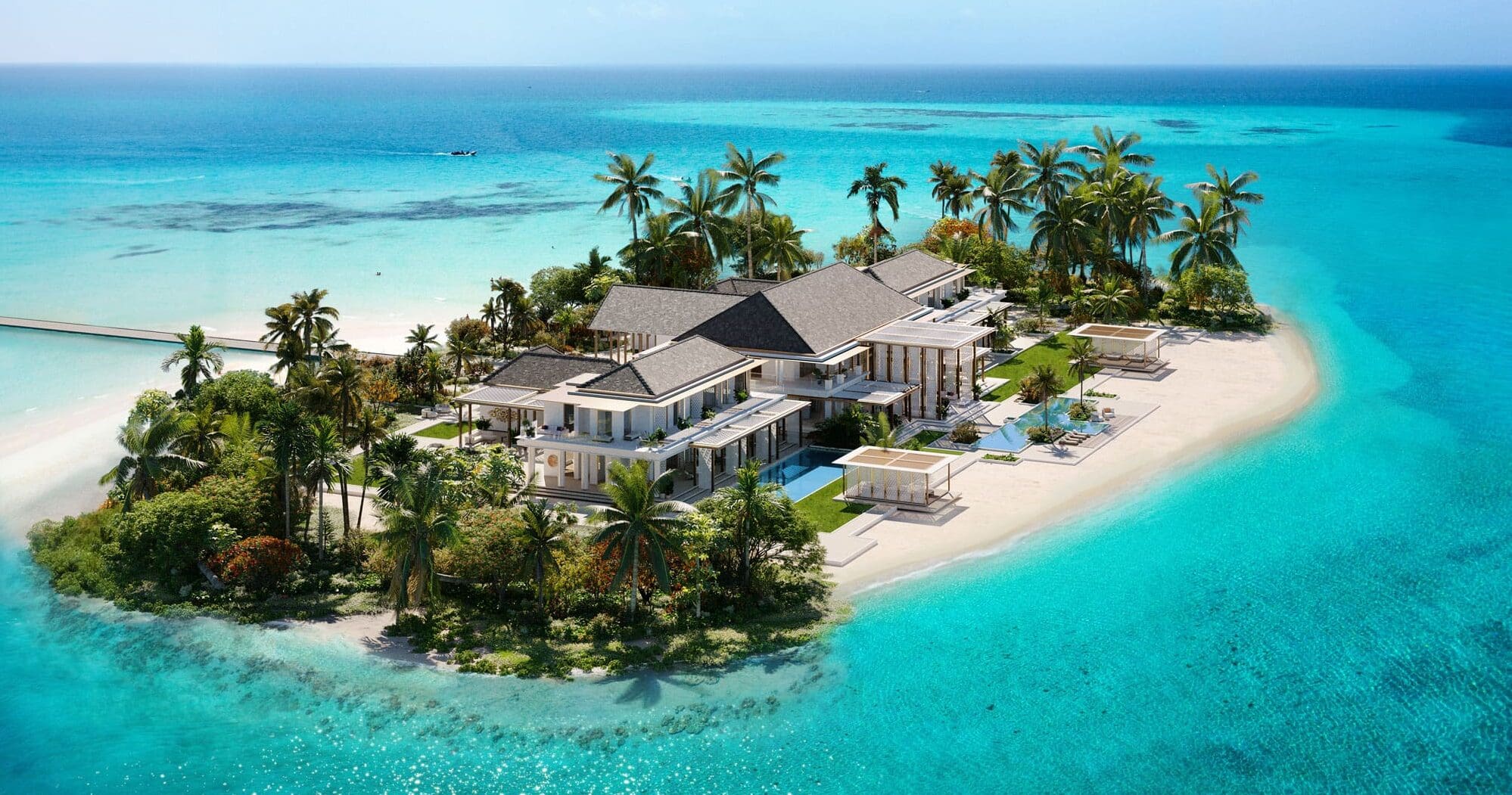
Trump International Hotel & Resort Maldives is planned as an ultra-luxury mixed-use hospitality development located within a private lagoon in Noonu Atoll, approximately 25 minutes by speedboat from Velana International Airport in Malé.
According to information released by DarGlobal and Trump Hotels, the development is expected to comprise approximately eighty luxury villas, including beachfront residences and overwater villas designed to combine private ownership with professionally managed hospitality operations.
The project is scheduled for completion by the end of 2028.
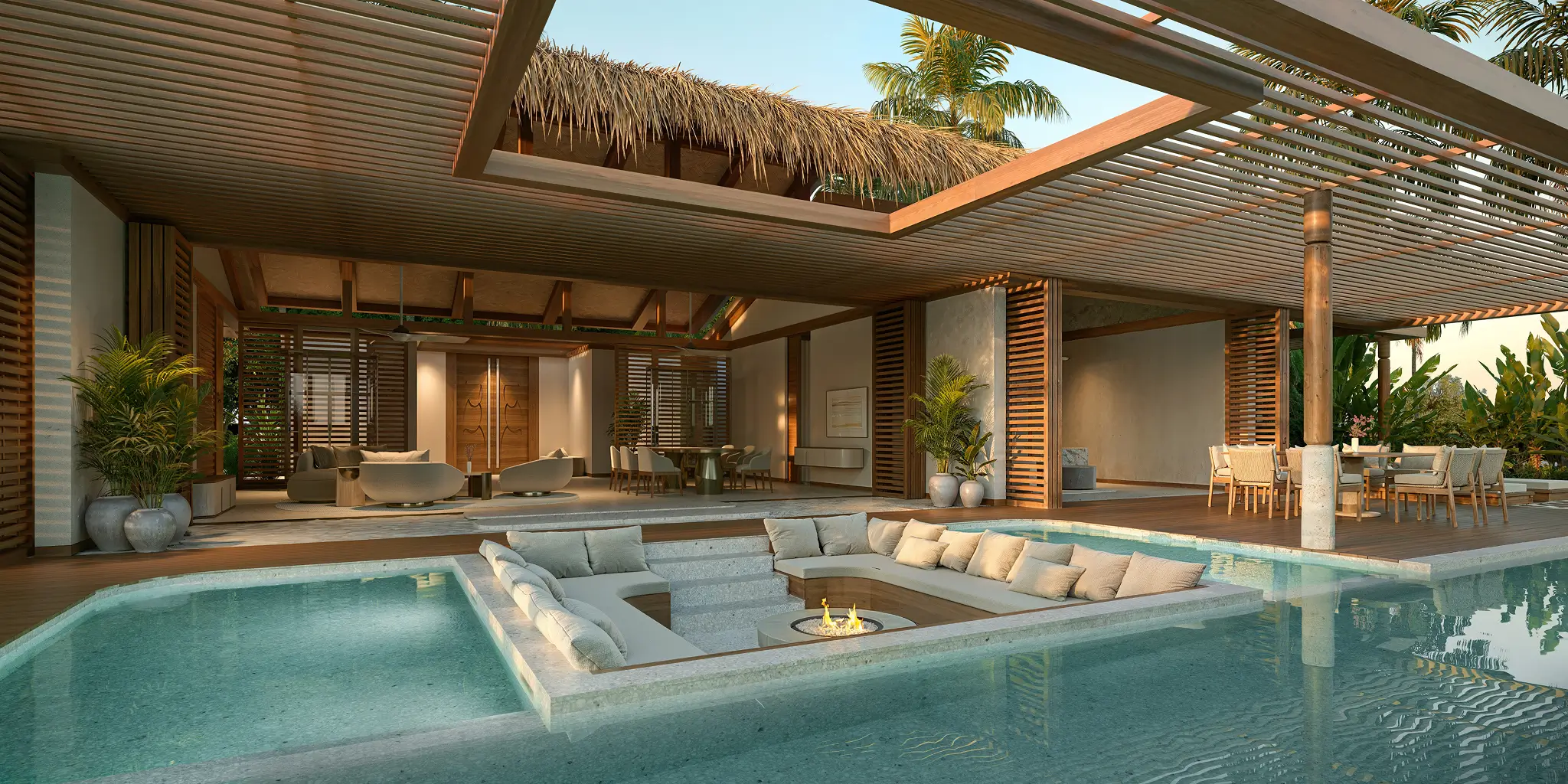
The architectural concept follows the contemporary Maldivian luxury resort model, characterised by large beachfront villas, overwater residences, uninterrupted lagoon views, private swimming pools, high-end wellness facilities, multiple dining venues and integrated hospitality services.
Although the final operating model has not yet been published, DarGlobal positions the development as a branded hospitality asset rather than a conventional residential project.
Why This Project Matters
The significance of Trump International Hotel & Resort Maldives extends beyond the launch of another luxury resort. Three structural factors differentiate the development from many competing projects.
1. First Trump-Branded Resort in the Maldives
The project represents the first officially announced Trump-branded hospitality development in the Maldives.
Brand exclusivity plays an increasingly important role within the global branded residence market. International hospitality brands have demonstrated an ability to command pricing premiums in selected destinations through stronger international recognition, established quality standards and global marketing platforms.
Whether this premium ultimately translates into higher investment returns will depend on operational performance after opening and cannot be assessed at this stage.
2. London-Listed Developer
Unlike many privately owned offshore developers operating in island destinations, DarGlobal is listed on the London Stock Exchange.
This provides investors with access to audited annual reports, interim financial statements, regulatory disclosures and corporate governance documentation that are generally unavailable for privately held developers. For institutional investors, public reporting materially improves transparency and facilitates independent financial due diligence.
According to DarGlobal's audited FY2025 Annual Results:
| Metric | FY2025 |
|---|---|
| Revenue | ~USD 538.6 million |
| EBITDA | ~USD 126.6 million |
| Net profit | ~USD 100.8 million |
| Net Asset Value | ~USD 584.4 million |
| Available liquidity | >USD 311 million |
These figures indicate that DarGlobal has developed into one of the largest publicly listed luxury residential developers focused on branded real estate.
Nevertheless, corporate financial strength should not be interpreted as evidence that every individual project carries identical investment characteristics. Each development requires separate legal, financial and operational due diligence.
3. Supply-Constrained Destination
The Maldives remains one of the world's most supply-constrained hospitality markets. Unlike urban residential markets where additional supply can be created relatively quickly, the development of new resort islands is limited by geography, environmental regulation and government licensing.
Every new integrated resort requires long-term island lease rights, environmental approvals, extensive marine engineering, significant infrastructure investment and government permits. These structural barriers reduce the risk of uncontrolled oversupply compared with many other international resort markets.
Maldives Tourism Market
The Maldives continues to demonstrate strong long-term demand fundamentals.
According to official tourism statistics, the country welcomed approximately 2.25 million international visitors during 2025, representing continued growth compared with the previous year.
The resort segment remains the dominant accommodation category. Approximately 73% of international visitors stayed in resort properties, while the remainder were distributed among hotels, guesthouses and safari vessels.
The tourism industry is supported by a diversified visitor base spanning Europe, the Middle East, China, India, the United States and Southeast Asia. This diversified base reduces dependence on any single source market and has historically supported faster recovery following periods of global disruption.
Location Analysis – Noonu Atoll
Noonu Atoll has gradually established itself as one of the Maldives' premier ultra-luxury resort destinations. Unlike the more intensively developed South Malé Atoll, Noonu offers lower development density, larger private islands, extensive coral reef systems, deeper lagoons suitable for overwater villas and greater privacy.
The atoll is already home to several internationally recognised ultra-luxury resorts, including Soneva Jani, Cheval Blanc Randheli and Velaa Private Island. This places Trump International Hotel & Resort Maldives within one of the strongest competitive luxury clusters in the country.
However, premium positioning also means the project will compete directly with some of the highest-performing hospitality assets in the Indian Ocean. Its long-term success will therefore depend not only on brand recognition but also on service quality, operational execution and pricing strategy after opening.
Initial Institutional Assessment
At its current stage of development, Trump International Hotel & Resort Maldives should be viewed primarily as a premium branded hospitality development supported by a financially transparent publicly listed developer.
The project benefits from a globally recognised hospitality brand, a supply-constrained destination, an experienced listed developer and an attractive ultra-luxury market segment.
At the same time, investors should recognise that several critical commercial documents have not yet been released publicly. Without access to the hotel management agreement, rental programme structure, operating budget, service-charge schedule, legal ownership documentation and detailed sales agreements, it is not yet possible to undertake a complete institutional underwriting of the investment opportunity.
For this reason, the following sections of this report focus on independently verifying the developer, the competitive environment, the legal framework and the financial characteristics of comparable luxury hospitality assets before drawing investment conclusions.
2. Developer Analysis – DarGlobal PLC
Corporate Profile
DarGlobal PLC is a London-listed luxury real estate developer focused on internationally branded residential, hospitality and mixed-use projects. The company operates across several high-value markets, including the United Arab Emirates, Oman, Qatar, Saudi Arabia, Spain, the United Kingdom and the Maldives.
The company is positioned as an international luxury development platform, with a particular focus on branded residences and lifestyle-led real estate. Its brand partnerships include Trump, Marriott, Missoni, Pagani, Elie Saab and other globally recognised names.
For investors, DarGlobal's public listing is a significant point of differentiation. Many resort and branded-residence developers active in island destinations operate as privately held entities, where financial disclosure is limited. DarGlobal, by contrast, publishes regulated market announcements, financial results and investor information.
This does not eliminate development risk, but it gives investors access to a higher level of corporate transparency than is typical in privately promoted offshore resort projects.
Financial Performance
DarGlobal reported strong results for the financial year ended 31 December 2025. According to the company's FY2025 results:
| Metric | FY2025 |
|---|---|
| Revenue | ~USD 538.6 million |
| EBITDA | ~USD 126.6 million |
| Net profit | ~USD 100.8 million |
| Net Asset Value | ~USD 584.4 million |
| Available liquidity | ~USD 311.7 million |
| Return on Equity | ~17.3% |
These figures indicate that DarGlobal has scaled materially since listing and has become a meaningful player in the international branded luxury real estate sector.
However, it is important to distinguish between corporate-level financial performance and project-level investment security. A profitable listed developer does not automatically make every individual project low-risk. Investors still need to analyse the legal structure, project financing, escrow arrangements, construction guarantees and operator agreements for each specific development.
Balance Sheet and Liquidity
DarGlobal's reported liquidity position is relevant because international resort developments require significant upfront capital. Projects in the Maldives are especially capital intensive due to island infrastructure, marine logistics, staff accommodation, desalination, power generation, waste management and environmental compliance.
The company's available liquidity of approximately USD 311.7 million provides a stronger platform than many privately promoted resort projects. Nevertheless, investors should request project-specific confirmation of:
- committed funding for the Maldives development; - construction funding sources; - escrow or ring-fenced buyer funds; - development-cost budget; - contingency allocation; - contractor payment structure; - completion guarantees; - debt facilities related specifically to the project.
A corporate liquidity pool is useful, but it is not the same as a fully funded project account.
Development Pipeline
DarGlobal has expanded rapidly through a branded-development strategy. The company has announced and promoted projects across several luxury real estate markets, including Dubai, Muscat, Jeddah, Doha, London, Marbella and the Maldives.
Its Trump-branded cooperation is not limited to the Maldives. DarGlobal has also been involved in Trump-branded projects in Oman, Jeddah, Dubai and other international markets.
This repeated cooperation with the Trump brand creates a stronger operational and commercial precedent than a one-off licensing arrangement. It suggests that DarGlobal has an established framework for working with the brand owner.
For Trump International Hotel & Resort Maldives, this is positive from a branding and execution standpoint. However, the Maldives is a specialised hospitality market. Delivering a resort island is materially different from delivering an urban branded residence or golf-resort villa project in the Middle East.
Strategic Rationale for DarGlobal
The Maldives project fits DarGlobal's broader strategy in three ways. First, it expands the company into one of the world's strongest luxury hospitality markets. Second, it strengthens DarGlobal's branded-residence platform by combining ultra-luxury real estate, hospitality and investment access. Third, it introduces tokenisation as a financing and ownership-access concept, which may broaden the investor base beyond traditional private wealth buyers.
The tokenisation element is commercially significant but should be treated with caution. Public reporting indicates that DarGlobal has explored the possibility of financing a material portion of the Maldives project through tokenised investment participation. Until final regulatory, legal and economic terms are published, investors should not assume what rights token holders will receive, what income they may be entitled to, or how liquidity will function.
Tokenisation Considerations
The Maldives project has been described as the world's first tokenised hotel development project. In principle, tokenisation can allow fractional participation in real estate by issuing digital tokens linked to an asset, development or income stream.
However, tokenisation does not by itself reduce investment risk. It may create additional legal, regulatory, custody and liquidity questions. Investors should verify:
- whether tokens represent equity, debt, revenue participation or another economic right; - which jurisdiction governs the token structure; - whether securities-law approvals have been obtained; - whether retail investors are eligible; - how tokens can be transferred; - whether there is any secondary market; - what happens if the development is delayed; - whether token holders have direct recourse to the asset; - how income is calculated and distributed; - whether token holders rank ahead of or behind traditional creditors.
Until these details are disclosed, tokenisation should be analysed as an additional risk factor rather than treated as an investment advantage.
Corporate Strengths
DarGlobal has several strengths relevant to the Maldives project.
**1. Public-Market Transparency.** As a listed company, DarGlobal provides more financial visibility than many private developers active in emerging resort markets.
**2. Branded Development Experience.** The company has demonstrated the ability to structure and market projects with internationally recognised brands.
**3. International Sales Capability.** DarGlobal has access to global investor and broker networks, which is particularly important for branded residences aimed at international buyers.
**4. Luxury Positioning.** The company is focused on premium and ultra-luxury real estate, which aligns with the intended positioning of Trump International Hotel & Resort Maldives.
**5. Existing Trump Relationship.** The Maldives project benefits from an existing developer-brand relationship rather than an untested partnership.
Corporate and Execution Risks
Despite these strengths, several risks remain material.
**1. Rapid Expansion Risk.** DarGlobal has expanded quickly across multiple jurisdictions. Rapid international growth increases management complexity and may place pressure on execution capacity.
**2. Project-Level Funding Risk.** Corporate-level profitability does not confirm that every individual project is fully funded. Investors should request project-specific funding evidence.
**3. Delivery Risk.** The Maldives development is scheduled for completion by the end of 2028. Island hospitality projects face construction, logistics, weather, permitting and contractor risks.
**4. Regulatory Risk.** The tokenisation model may require approval from financial regulators depending on investor jurisdiction and legal structure.
**5. Brand-Perception Risk.** The Trump brand is globally recognised but can be polarising. It may create pricing power in certain investor segments while reducing appeal in others.
**6. Hospitality Execution Risk.** DarGlobal is primarily known as a luxury real estate developer. The long-term investment value of a resort asset will depend on hotel operations, not only development and sales.
Key Questions for Investors
Before treating the project as institutional-grade, investors should request written answers to the following:
- What is the legal ownership structure of the villas? - What is the leasehold term and renewal mechanism? - Is buyer money held in escrow? - Has full project financing been secured? - Who is the hotel operator? - What is the role of Trump Hotels after opening? - Is there a hotel management agreement in place? - What are the rental-pool terms? - What are the expected service charges? - What are the management and brand fees? - What rights do token holders receive? - Are tokenised investments regulated as securities? - What guarantees protect buyers if completion is delayed? - What is the resale process? - Are there restrictions on owner usage?
Developer Assessment
DarGlobal appears to be a credible developer at the corporate level. Its FY2025 financial results show strong revenue growth, profitability, liquidity and net asset value. Its London listing provides a level of transparency that is valuable for investors.
However, the Trump International Hotel & Resort Maldives project should not be evaluated solely on the basis of DarGlobal's corporate financials. The relevant investment decision depends on project-level documents that are not yet fully public.
The correct conclusion is therefore balanced. DarGlobal strengthens the credibility of the project compared with an opaque private developer. However, institutional investors should still require full legal, financial and operational due diligence before treating the project as a fully underwritten investment opportunity.
Interim Verdict
From a developer-risk perspective, DarGlobal is a stronger counterparty than many privately held developers operating in luxury resort markets. Its public listing, audited results, international brand partnerships and existing relationship with Trump Hotels are positive factors.
At the same time, the Maldives project involves additional complexity due to its island location, hospitality operating model and proposed tokenisation structure.
The investment case remains attractive at concept level, but it is not yet complete at underwriting level. The next stage of analysis should therefore focus on the Maldives hospitality market, comparable ultra-luxury resorts, operating performance benchmarks and the level of competition Trump International Hotel & Resort Maldives will face after opening.
3. Maldives Hospitality Market and Competitive Benchmark
Market Overview
The Maldives remains one of the most distinctive luxury hospitality markets in the world. Its competitive advantage is based on a combination of geography, limited land supply, high international brand recognition and the "one island, one resort" development model.
In 2025, the Maldives continued to record strong tourism performance. Industry and official tourism reporting indicate that the country welcomed approximately 2.25 million international visitors during 2025. December 2025 also became the highest-ever month for tourist arrivals to the Maldives, with 224,455 visitors, underlining strong peak-season demand and the continued appeal of the destination among international travellers.
The accommodation base remains heavily resort-led. As of 2025, the Maldives had approximately 178 operational resorts with around 44,697 resort beds. Additional supply was provided by hotels, guesthouses and safari vessels. The resort category remains the most relevant accommodation segment for Trump International Hotel & Resort Maldives, because the project is positioned as a fully integrated ultra-luxury hospitality asset rather than a city hotel, guesthouse or conventional residential development.
The Maldives Monetary Authority and tourism statistics sources track resort occupancy as a key market indicator. Publicly available 2025 market summaries indicate average resort occupancy of approximately 58%, although performance varies significantly by resort, location, brand, villa mix, seasonality and source markets.
Structural Market Drivers
The Maldives benefits from several long-term drivers that support investment interest in the luxury resort sector.
**1. Limited Physical Supply.** The Maldives is a geographically constrained market. New resort development is limited by island availability, lagoon conditions, reef systems, environmental regulation and government approvals. This makes the market structurally different from urban hotel markets, where new room supply can often be added more easily.
For investors, this scarcity is important. It does not guarantee investment returns, but it supports long-term asset defensibility when combined with a strong brand, high service quality and effective operations.
**2. One Island, One Resort Model.** The traditional Maldivian resort model gives each property a high degree of privacy and spatial control. This is one of the destination's strongest selling points for high-net-worth and ultra-high-net-worth guests.
Trump International Hotel & Resort Maldives appears to follow this logic by focusing on a limited number of ultra-luxury beach and overwater villas. The scale of approximately 80 villas is consistent with a low-density resort model rather than a high-volume hospitality product.
**3. Global Source Markets.** Demand for the Maldives is globally diversified. The destination attracts travellers from Europe, the Middle East, India, China, the United States and other Asian markets.
This diversified demand base reduces reliance on one single country, although source-market changes can still materially influence performance. Chinese outbound travel, Indian demand, Middle Eastern high-spend travel and European winter-season demand are all relevant to future resort performance.
**4. USD-Denominated Hospitality Revenue.** Luxury resort revenue in the Maldives is generally quoted and collected in US dollars. For international investors, this can be attractive because it reduces exposure to weaker local-currency revenue.
However, USD revenue does not eliminate cost risk. Resort operations in the Maldives are highly dependent on imported food, beverages, equipment, construction materials, fuel, specialised labour and marine logistics.
**5. Luxury and Privacy-Led Demand.** The Maldives has retained strong appeal in segments such as honeymoons, wellness travel, diving, family luxury, private-island stays and high-end experiential tourism.
This demand profile supports premium pricing, but only for properties that deliver exceptional service standards and maintain strong international distribution.
Market Constraints and Pressure Points
The Maldives is attractive, but it is not a low-risk hospitality market. The key constraints include:
- high construction costs; - dependence on imported materials; - expensive logistics; - staff accommodation requirements; - power, water and waste infrastructure costs; - climate and erosion risk; - coral reef protection requirements; - seasonal demand fluctuations; - increasing competition in the luxury resort segment; - vulnerability to air-connectivity changes; - exposure to global luxury travel cycles.
These constraints are particularly relevant for a new resort under development, because the final investment outcome depends on both construction execution and post-opening operating performance.
Location Context: Noonu Atoll
Noonu Atoll is one of the Maldives' strongest ultra-luxury resort clusters.
The atoll is associated with privacy-led, high-end hospitality and already hosts several globally recognised luxury resorts. Its positioning is more exclusive than many more densely developed areas closer to Malé.
For Trump International Hotel & Resort Maldives, Noonu Atoll offers a positive destination signal. The presence of established ultra-luxury resorts validates the area's appeal among high-spend travellers.
However, this also creates a demanding competitive environment. The project will not be competing against mid-market resorts. It will compete against some of the most recognised luxury properties in the Indian Ocean.
Competitive Set
The most relevant competitive set includes ultra-luxury resorts with strong brand equity, private-island positioning, premium villa inventory and international distribution.
**Key Comparable Resorts**
| Resort | Location | Positioning | Competitive Relevance |
|---|---|---|---|
| Soneva Jani | Noonu Atoll | Ultra-luxury, sustainability, experiential luxury | Direct Noonu Atoll benchmark |
| Cheval Blanc Randheli | Noonu Atoll | LVMH-backed ultra-luxury hospitality | Top-tier luxury benchmark |
| Velaa Private Island | Noonu Atoll | Ultra-private, UHNW-focused resort | Privacy and exclusivity benchmark |
| One&Only Reethi Rah | North Malé Atoll | Established ultra-luxury resort brand | Mature luxury operating benchmark |
| Waldorf Astoria Maldives Ithaafushi | South Malé Atoll | Global branded luxury resort | International brand benchmark |
| St. Regis Maldives Vommuli Resort | Dhaalu Atoll | Marriott luxury brand, high-end villa product | Branded luxury benchmark |
| Four Seasons Resort Maldives at Landaa Giraavaru | Baa Atoll | Institutional-grade luxury operator | Operational excellence benchmark |
| Patina Maldives, Fari Islands | North Malé Atoll | Contemporary luxury and design-led positioning | New-generation lifestyle luxury benchmark |
This competitive group is materially different from the broader Maldives resort market. These properties compete for high-spend international guests and are relevant because Trump International Hotel & Resort Maldives is positioned in the same aspirational category.
Benchmark Interpretation
The existence of strong competitors in Noonu Atoll is both positive and challenging.
On the positive side, it confirms that the atoll is already accepted by the global luxury market. This reduces location risk and supports the argument that high-end demand exists for this part of the Maldives.
On the negative side, the project must meet or exceed the service expectations already established by leading resorts such as Soneva Jani, Cheval Blanc Randheli and Velaa Private Island.
For an ultra-luxury resort, brand recognition alone is not sufficient. Guests and buyers will evaluate:
- villa size and privacy; - arrival experience; - beach and lagoon quality; - reef quality; - food and beverage standards; - wellness offering; - marine activities; - service ratios; - design quality; - sustainability credentials; - family and couple segmentation; - digital reputation after opening.
ADR, RevPAR and GOPPAR Benchmarking
A full institutional comparison would normally include:
- ADR; - occupancy; - RevPAR; - total revenue per occupied villa; - GOP margin; - GOPPAR; - payroll cost ratio; - food and beverage contribution; - spa and wellness revenue; - owner-rental distribution; - net operating income.
However, reliable property-level operating data for individual ultra-luxury Maldives resorts is generally not publicly disclosed. STR, hotel operators and institutional investors may have access to confidential benchmarking data, but these figures are not normally available in public sources.
Therefore, this report does not assign specific ADR, RevPAR or GOPPAR figures to Trump International Hotel & Resort Maldives or its individual competitors.
This is an important analytical limitation.
Any article or investment presentation that shows precise ADR, RevPAR, ROI or IRR for Trump International Hotel & Resort Maldives without citing official project documentation, hotel management agreements or independent hospitality benchmarking data should be treated with caution.
What Can Be Verified Publicly
The following points can be verified from public sources:
- the Maldives remains a major global luxury tourism destination; - the country recorded approximately 2.25 million tourist arrivals in 2025; - the resort segment remains the dominant accommodation category; - the Maldives had approximately 178 operational resorts and around 44,697 resort beds in 2025; - Noonu Atoll is already home to several leading ultra-luxury resorts; - Trump International Hotel & Resort Maldives is announced as an approximately 80-villa project; - the project is planned to open by the end of 2028; - the project is described as being approximately 25 minutes by speedboat from Malé.
What Cannot Yet Be Verified Publicly
The following items have not been publicly disclosed in sufficient detail:
- expected ADR for Trump International Hotel & Resort Maldives; - projected occupancy; - projected RevPAR; - projected GOPPAR; - projected rental income for villa owners; - service-charge budget; - hotel management fee; - brand fee; - FF&E reserve contribution; - owner-use restrictions; - resale assumptions; - expected ROI; - expected IRR.
These items are necessary for full financial underwriting. Until they are disclosed, the investment case can be analysed qualitatively, but not fully underwritten quantitatively.
Market Positioning Assessment
Trump International Hotel & Resort Maldives enters a market with strong macro fundamentals but intense competition at the luxury end.
**Its advantages include:**
- first Trump-branded resort in the Maldives; - limited villa inventory; - proximity to Malé by speedboat; - DarGlobal's branded-development platform; - location within a globally recognised luxury destination; - exposure to a mature USD-denominated hospitality market.
**Its challenges include:**
- competition from established ultra-luxury resorts; - absence of disclosed operating projections; - need to prove service quality after opening; - execution risk before 2028 completion; - uncertainty around tokenisation structure; - long-term environmental exposure.
Competitive Verdict
The Maldives market supports the strategic logic of the project. Noonu Atoll is a credible ultra-luxury location, and the presence of recognised competitors confirms demand for high-end hospitality in the area.
However, the project should not be described as financially superior to competing resorts unless verified operating data becomes available.
At this stage, the correct conclusion is that Trump International Hotel & Resort Maldives has strong positioning potential, but its actual investment performance will depend on factors that are not yet publicly disclosed:
- final construction quality; - opening timeline; - operator execution; - pricing strategy; - occupancy performance; - cost control; - rental-pool mechanics; - buyer protections; - long-term environmental resilience.
From a market perspective, the project is credible. From an investment-underwriting perspective, it remains incomplete until full financial and legal documentation is available.
4. Investment Assessment, Due Diligence and Final Verdict
Investment Perspective
Trump International Hotel & Resort Maldives is positioned as a premium branded hospitality real estate development rather than a conventional residential investment.
Its investment profile combines several characteristics that are increasingly sought after by international investors:
- globally recognised branding; - limited inventory; - location within one of the world's most established luxury resort destinations; - development by a publicly listed company; - exposure to USD-denominated hospitality revenues.
These characteristics create a compelling investment narrative. However, professional investors distinguish between an attractive concept and a fully underwritten investment.
At the time of writing, the project should be considered an advanced development opportunity rather than a completed investment product.
The distinction is important because a development project carries different risks from an operating hospitality asset with an established financial track record.
Institutional Due Diligence Framework
Institutional investors typically evaluate hospitality developments across four principal areas.
**1. Legal Due Diligence**
Before committing capital, investors should verify:
- legal ownership structure; - island lease documentation; - lease duration; - renewal rights; - rights granted to foreign buyers; - transfer restrictions; - inheritance provisions; - governing law; - dispute resolution mechanism; - registration procedures; - compliance with Maldivian investment regulations.
The legal framework ultimately determines the enforceability of ownership rights and exit options.
**2. Development Due Diligence**
Investors should request confirmation of:
- construction permits; - environmental approvals; - Environmental Impact Assessment (EIA); - contractor appointment; - construction programme; - procurement strategy; - engineering supervision; - insurance coverage; - contingency planning; - completion guarantees.
Island developments require considerably more complex logistics than conventional urban projects. Marine transport, weather conditions, imported construction materials and environmental restrictions all increase execution risk.
**3. Commercial Due Diligence**
The following commercial documentation should be available before any investment decision:
- reservation agreement; - sales and purchase agreement; - payment schedule; - escrow arrangements; - hotel management agreement; - rental programme agreement; - owner usage policy; - service charge budget; - management fee schedule; - FF&E reserve contributions; - projected operating budget.
These documents determine the economic relationship between the investor, the operator and the developer.
**4. Financial Due Diligence**
Professional investors require a fully integrated financial model. The following information has not yet been publicly disclosed:
- projected ADR; - projected occupancy; - RevPAR; - GOPPAR; - operating expenses; - owner distributions; - projected cash flow; - projected ROI; - projected IRR; - sensitivity analysis.
Without these data, a full financial underwriting cannot be completed.
Risk Assessment
Every hospitality investment involves risk. The objective is not to eliminate risk but to understand it.
**Development Risk**
The project remains under development. Potential risks include:
- construction delays; - contractor performance; - supply-chain disruption; - permitting delays; - inflation; - currency volatility during construction.
**Operational Risk**
The value of a hospitality asset depends on hotel performance. Future returns will depend on:
- occupancy; - pricing strategy; - service quality; - online reputation; - cost management; - international distribution; - repeat guest ratios.
Brand recognition alone does not guarantee commercial success.
**Regulatory Risk**
Maldives legislation relating to tourism, taxation, environmental protection and foreign investment may evolve over time. Investors should monitor:
- tourism taxes; - lease legislation; - environmental regulation; - foreign ownership rules; - investment law.
**Environmental Risk**
Climate change is a material consideration for all low-lying island destinations. Investors should evaluate:
- coastal erosion; - reef degradation; - sea-level rise; - storm resilience; - infrastructure resilience; - long-term adaptation measures.
Professional investors increasingly assess ESG performance alongside financial performance.
**Liquidity Risk**
Luxury hospitality real estate is generally less liquid than conventional residential property. Future resale value depends on:
- market conditions; - brand strength; - operating performance; - buyer demand; - legal transferability.
Exit periods may therefore be longer than investors expect.
**Tokenisation Risk**
DarGlobal has announced plans involving tokenisation. Although innovative, tokenisation introduces additional considerations:
- investor rights; - regulatory treatment; - custody arrangements; - transferability; - secondary-market liquidity; - taxation.
Until the legal framework is fully documented, tokenisation should be viewed as a developing component of the investment rather than an established market standard.
ESG Considerations
Environmental, Social and Governance (ESG) factors are becoming increasingly relevant in hospitality investment. Investors should evaluate:
**Environmental**
- renewable energy strategy; - water management; - desalination systems; - wastewater treatment; - coral reef protection; - biodiversity programmes; - carbon reduction initiatives.
**Social**
- local employment; - workforce accommodation; - health and safety; - community engagement; - employee training.
**Governance**
- transparency; - financial reporting; - compliance; - audit; - risk management; - anti-corruption procedures.
The availability of ESG reporting may influence institutional investor appetite.
Investment Strengths
The project demonstrates several notable strengths.
**Corporate**
- London-listed developer; - audited financial statements; - established international platform.
**Location**
- Noonu Atoll; - private lagoon; - recognised luxury destination.
**Brand**
- first Trump-branded resort in the Maldives; - international brand recognition.
**Market**
- structurally limited supply; - resilient luxury tourism sector; - diversified international visitor base.
**Product**
- approximately 80 villas; - low-density development; - integrated hospitality concept.
Investment Weaknesses
Several questions remain unanswered. The following information has not yet been published in sufficient detail:
- villa pricing; - operating projections; - hotel management contract; - rental programme mechanics; - owner cash-flow assumptions; - legal ownership documentation; - detailed service-charge schedule; - buyer protection mechanisms.
These omissions prevent full institutional underwriting.
Information Investors Should Request
Before signing a reservation agreement, investors should request:
1. Full legal documentation. 2. Sales agreement. 3. Hotel management agreement. 4. Rental programme agreement. 5. Detailed payment schedule. 6. Escrow confirmation. 7. Construction timeline. 8. Independent valuation. 9. Service charge budget. 10. Management fee schedule. 11. Insurance arrangements. 12. Environmental approvals. 13. Engineering reports. 14. Tokenisation legal framework. 15. Exit strategy documentation.
Institutional investors would normally require all of these documents before approving an acquisition.
Final Investment Verdict
Trump International Hotel & Resort Maldives represents one of the most visible branded hospitality developments currently announced in the Maldives.
From a strategic perspective, the project benefits from:
- an internationally recognised hospitality brand; - development by a publicly listed company; - location within a globally established luxury tourism destination; - limited inventory; - positioning within the premium branded-residence segment.
These characteristics provide a strong commercial foundation.
However, professional investment analysis requires more than brand recognition. At present, several key commercial and legal documents remain unavailable in the public domain. Consequently, the project cannot yet be classified as a fully underwritten institutional investment opportunity.
The appropriate conclusion is therefore balanced.
Trump International Hotel & Resort Maldives appears to have the characteristics of a potentially attractive luxury hospitality investment. Nevertheless, investors should complete comprehensive legal, financial, technical and operational due diligence before making any investment decision.
Until detailed financial assumptions, ownership documentation and operating agreements are disclosed, investment decisions should be based on verified evidence rather than marketing materials or projected returns.
Overall Assessment
| Category | Assessment |
|---|---|
| Developer credibility | Very Strong |
| Financial transparency | Strong at corporate level |
| Project transparency | Moderate |
| Market fundamentals | Strong |
| Location quality | Excellent |
| Brand positioning | Strong |
| Legal transparency | Incomplete |
| Financial disclosure | Incomplete |
| Investment underwriting | Not yet possible |
| Overall project potential | High, subject to successful due diligence |
Disclaimer
This report has been prepared using publicly available information published by DarGlobal PLC, Trump Hotels, the London Stock Exchange, the Ministry of Tourism of the Maldives, the Maldives Monetary Authority and recognised hospitality industry sources.
Where project-specific information has not been publicly disclosed, no assumptions or financial projections have been introduced. Investors should obtain independent legal, financial and tax advice before making any investment decision.
Sources
- DarGlobal PLC – FY2025 Annual Results - DarGlobal – Trump International Hotel & Resort Maldives - Trump Hotels – Official project page - Ministry of Tourism, Maldives – Tourism Statistics 2025 - Maldives Monetary Authority – Annual Economic Review