Warsaw Retail Real Estate: Commercial Units, Retail Parks and Investment Opportunities
Warsaw has become one of Central Europe's most resilient retail property markets. A sourced, format-by-format analysis of shopping centres, retail parks, high street, convenience and mixed-use investments for private and institutional capital.
Executive Summary
Warsaw has become one of the most resilient retail property markets in Central and Eastern Europe. Unlike many mature Western European cities, where retail growth is constrained by limited development opportunities and saturated consumer markets, Warsaw continues to benefit from structural economic expansion, population growth within its metropolitan area, rising household incomes and sustained interest from both domestic and international retailers.
The city’s attractiveness is not based on a single factor. It results from the combination of macroeconomic strength, demographic scale, transport infrastructure, purchasing power and its position as Poland’s undisputed business and financial centre.
For investors, Warsaw offers exposure to several distinct retail formats, each characterised by different risk profiles, expected returns and liquidity:
high street retail,
shopping centres,
retail parks,
convenience retail,
mixed-use developments,
commercial units within residential schemes,
standalone leased investment properties.
Although all belong to the retail asset class, they should not be analysed using the same investment framework. A leased grocery unit in a residential district, a prime luxury unit on Nowy Świat and a retail park anchored by discount retailers represent fundamentally different investment products.
Understanding those differences has become increasingly important as capital markets have entered a new phase. Following the repricing observed in 2022–2024, investors have shifted their focus from speculative capital appreciation towards sustainable income, tenant quality and long-term resilience.
Retail property has therefore returned to the investment agenda—but in a different form than during the previous cycle.
Today’s institutional investors are less interested in “shopping centres” as a category and more interested in income-producing assets supported by necessity-based consumption, omnichannel retail and locations with proven liquidity.
This report examines Warsaw’s retail market through that lens.
Introduction
Retail real estate has undergone one of the most significant transformations of any commercial property sector during the past decade.
The rapid expansion of e-commerce initially led many analysts to predict a structural decline in physical retail. While online commerce has permanently altered consumer behaviour, it has not eliminated the need for physical stores. Instead, it has fundamentally changed their role.
Modern retail is increasingly omnichannel.
Consumers research products online, compare prices digitally, order through mobile applications and often complete purchases either in-store or through click-and-collect services. Physical retail has therefore evolved from being solely a point of sale into a critical component of customer experience, logistics and brand presence.
This evolution has had a profound impact on investment strategies.
Institutional investors increasingly distinguish between retail formats that are vulnerable to digital substitution and those that benefit from changing consumer behaviour.
Retail parks, neighbourhood convenience centres and well-located commercial units integrated into residential districts have generally demonstrated stronger resilience than traditional secondary shopping centres. This trend has been observed not only in Poland but across most European markets.
According to Colliers, retail parks remain the dominant format within Poland’s development pipeline, reflecting continued developer and investor confidence in convenience-based retail. (Colliers)
CBRE likewise reports that all new retail schemes completed during the first quarter of 2026 in Poland were retail parks, reinforcing the structural shift towards smaller, convenience-oriented formats rather than large enclosed shopping centres. (CBRE)
Warsaw illustrates this transition particularly well.
The city combines mature regional shopping centres with rapidly expanding mixed-use districts, extensive residential development and one of Europe’s strongest consumer markets within Central and Eastern Europe.
Rather than competing against e-commerce, many retail assets now support it.
The question for investors is therefore no longer whether physical retail has a future.
The more relevant question is:
Which retail assets will continue generating sustainable income over the next decade?
Why Warsaw?
Few cities in Central Europe combine economic scale, purchasing power and market liquidity as effectively as Warsaw.
As Poland’s capital and largest metropolitan economy, Warsaw performs multiple roles simultaneously.
It is the country’s political centre.
Its largest office market.
Its financial hub.
Its primary destination for international retailers entering Poland.
Its largest consumer market.
Its largest labour market.
Its most liquid commercial property market.
These characteristics make Warsaw fundamentally different from every other Polish city.
While regional cities such as Kraków, Wrocław or Poznań have developed sophisticated retail markets, Warsaw benefits from a concentration of headquarters, higher disposable incomes and the country’s largest concentration of white-collar employment.
From an investment perspective, this translates into stronger tenant demand, deeper occupier markets and higher exit liquidity.
International retailers frequently establish their first Polish flagship stores in Warsaw before expanding into regional markets.
This phenomenon has been documented repeatedly by JLL, whose European Retail City Profile identifies Warsaw as Poland’s principal gateway for international retail brands. JLL also forecasts nominal retail sales growth averaging approximately 5.6% annually between 2025 and 2029, outperforming the national average. (Colliers)
Consumer demand remains one of the city’s greatest strengths.
Colliers notes that household consumption has been the primary contributor to Poland’s recent GDP growth, accounting for approximately two-thirds of economic expansion in 2024. Warsaw, benefiting from the country’s highest concentration of higher-income households, captures a disproportionate share of that spending. (Colliers)
For retailers, this creates a favourable operating environment.
For investors, it supports tenant demand.
Warsaw Within the European Retail Landscape
Warsaw occupies an increasingly important position within the European retail hierarchy.
Although the city cannot yet be directly compared with London, Paris or Milan in terms of luxury retail depth, it has become one of the strongest retail destinations in Central and Eastern Europe.
Its advantages include:
the largest metropolitan consumer base in Poland,
relatively high purchasing power compared with other CEE capitals,
excellent motorway and public transport infrastructure,
a diversified labour market,
strong office demand supporting daytime footfall,
continued residential expansion,
growing tourism,
relatively low structural unemployment,
high market transparency.
Unlike several Western European cities where retail supply is constrained by historic urban fabric, Warsaw continues to evolve through large-scale regeneration projects, mixed-use developments and residential expansion.
This creates investment opportunities that are increasingly difficult to find in mature Western markets.
However, investors should avoid assuming that every retail asset in Warsaw benefits equally from these structural trends.
The city’s retail market is highly segmented.
Prime high street units operate under different economic conditions than neighbourhood convenience retail.
Retail parks follow different leasing dynamics than enclosed shopping centres.
Commercial units within new residential projects depend primarily on local catchment areas rather than city-wide footfall.
Each format therefore requires its own investment strategy.
Understanding these structural differences is essential before analysing pricing, yields or acquisition opportunities.
Those topics are examined in the following chapters.
Macroeconomic Fundamentals of Warsaw
Warsaw’s retail investment case begins with the scale and quality of its underlying economy.
The city is not merely Poland’s largest retail market. It is the country’s principal centre of business services, finance, public administration, technology, professional employment and corporate decision-making. This concentration of economic activity supports retail demand through higher employment density, stronger household incomes, business travel, tourism and a large daytime population.
For retail investors, these factors matter because rental sustainability ultimately depends on occupier turnover. A store, restaurant, medical unit or neighbourhood service business can only support rent if the surrounding catchment produces sufficient and recurring expenditure.
Warsaw offers several sources of that expenditure:
permanent residents;
commuters;
office employees;
students;
domestic and international visitors;
business travellers;
residents of the wider metropolitan area.
This makes the city’s effective consumer market substantially broader than its administrative population alone.
At the end of 2025, Warsaw had a registered population of 1,866,729. The Warsaw metropolitan area extends significantly beyond the city boundary and, according to the city’s economic development documentation, comprises more than three million inhabitants across approximately 6,000 sq km. (Urząd Statystyczny w Warszawie)
This distinction is critical for retail analysis. The customer base of a Warsaw shopping centre, retail park or destination store cannot be assessed solely by the population of the district in which it is located. Many assets serve catchments extending into suburban municipalities connected to the city through road, rail and public transport infrastructure.
The investment implication is straightforward:
Warsaw should be analysed as a metropolitan retail economy, not merely as an administrative city.
Employment and Income Support Retail Demand
Warsaw’s labour market remains one of the strongest foundations of its retail property sector.
According to the Statistical Office in Warsaw, average employment in the city amounted to approximately 1.106 million people in May 2026. The registered unemployment rate was 1.6%, while the average monthly gross salary in the enterprise sector reached PLN 11,204.68. (Urząd Statystyczny w Warszawie)
These figures should be interpreted carefully.
The published average salary does not represent the disposable income of every Warsaw household. It is an average for the enterprise sector and can be influenced by the concentration of highly paid industries, management functions and corporate headquarters. It nevertheless confirms that the city has a relatively deep base of professional employment and household purchasing capacity.
For retail landlords, a low unemployment rate is generally supportive because it increases household confidence and reduces the risk of a prolonged decline in discretionary spending. At the same time, a tight labour market creates operating pressure for retailers, restaurants and service providers through higher wage costs and recruitment difficulties.
This creates a two-sided effect:
stronger employment supports consumer expenditure;
higher labour costs can reduce tenant margins and rental affordability.
Retail underwriting should therefore not rely only on the apparent wealth of the catchment. Investors should also examine whether the occupier’s business model can absorb Warsaw’s payroll, energy and occupancy costs.
The strongest tenants are not necessarily those generating the highest sales. They are those capable of converting revenue into sustainable site-level profitability after rent, service charges, wages and other operating expenses.
Population Growth and Migration
Warsaw continues to attract residents despite the broader demographic challenges facing Poland.
City data published in 2025 recorded 1,863,845 residents, with positive domestic net migration of 2,533 people and positive international net migration of 1,857 people. The same dataset identified Mokotów, Praga-Południe and Białołęka as the city’s three most populous districts. (Urząd Miasta Warszawy)
The Statistical Office subsequently reported a year-end 2025 population of 1,866,729, confirming continued growth in the registered population. (Urząd Statystyczny w Warszawie)
For retail investors, migration is more important than the headline population number alone.
Population growth changes the location of demand. In Warsaw, new residential construction and suburban expansion create retail opportunities outside traditional shopping districts. Grocery stores, pharmacies, medical services, fitness, childcare, food service and personal services often follow housing development with a delay.
That delay can create opportunity, but it also creates risk.
A commercial unit delivered in a new residential project may appear to serve a large future catchment, while the actual population, pedestrian flows and tenant demand remain insufficient during the initial years. Investors should therefore distinguish between:
existing occupied catchment;
population currently under construction;
permitted future development;
speculative long-term development assumptions.
Only the first two categories should normally form the core of a conservative rental underwriting.
Positive migration also does not eliminate demographic segmentation. Different districts attract different age, income and household profiles. A unit suitable for premium gastronomy in Śródmieście may be unsuitable for a new family-oriented residential district. A discount grocery store may perform well in a location where an international fashion brand would fail.
The relevant question is not simply whether the population is growing.
It is:
Who is moving into the catchment, what do they spend money on, and how frequently do they use local retail?
District-Level Differences Matter
Warsaw is not one homogeneous consumer market.
The city’s districts differ in population density, age profile, household wealth, housing typology, public transport accessibility, employment concentration and future development pipeline.
City statistics identify Praga-Południe, Ochota and Wola among the districts with the highest population density, while Mokotów, Praga-Południe and Białołęka are among the most populous. (Urząd Miasta Warszawy)
These differences influence retail formats.
High-density districts may support:
convenience stores;
pharmacies;
food service;
beauty and personal services;
medical units;
smaller urban retail formats.
Lower-density but rapidly growing districts may support:
neighbourhood retail centres;
grocery-anchored schemes;
retail parks;
drive-through food service;
family-oriented services;
larger-format stores with parking.
Central districts benefit from office workers, tourism, public transport and destination shopping. Outer districts and suburban locations depend more heavily on local residents, car access and the quality of everyday convenience.
This means that a citywide average rent or vacancy rate has limited value when analysing an individual retail unit.
Professional investment analysis should use a micro-catchment approach, covering:
residents within a realistic walking or driving time;
competing retail supply;
planned housing;
workplace population;
public transport;
parking;
pedestrian routes;
visibility;
road access;
barriers such as railways, rivers or major roads.
In Warsaw, a distance of one kilometre can materially change a retail catchment if the urban layout restricts movement.
The Wider Metropolitan Consumer Base
Warsaw’s retail economy extends into neighbouring municipalities such as Piaseczno, Pruszków, Marki, Łomianki, Ząbki, Legionowo, Ożarów Mazowiecki and other parts of the metropolitan area.
The city’s Economic Development Policy describes the wider metropolitan area as a territory of approximately 6,000 sq km with more than three million residents. (Urząd m.st. Warszawa)
This wider region creates demand for:
retail parks near major roads;
grocery-anchored convenience schemes;
home improvement stores;
furniture and household retail;
drive-through restaurants;
automotive services;
leisure and family entertainment;
logistics-supported omnichannel retail.
The metropolitan market also explains why some of Warsaw’s most important retail assets are located outside the strict city centre or even outside the city’s administrative boundary.
For retail park investment, the relevant market is often the Warsaw agglomeration rather than Warsaw itself.
However, metropolitan locations must be evaluated with discipline. Large population numbers do not automatically translate into effective demand. Investors must analyse road patterns, travel times, competition and whether the asset is located on the natural route between homes, workplaces and other destinations.
A retail park positioned near a major road may appear highly visible but still have limited access from the relevant traffic direction. Similarly, a densely populated municipality may already be served by several competing grocery and convenience schemes.
The decisive metric is not the number of cars passing the site.
It is the number of potential customers who can enter, park, shop and leave conveniently.
Consumer Spending and the National Economic Context
Warsaw benefits from the broader recovery in Polish household consumption, but investors should distinguish between nominal and real growth.
JLL forecasts that nominal retail sales in Warsaw will grow by an average of 5.6% per year between 2025 and 2029, above the forecast national rate. This projection reflects Warsaw’s relatively strong consumer base, although nominal growth includes the effect of prices and should not be interpreted as equivalent to volume growth. (jll.com)
National data from Statistics Poland showed that retail sales at constant prices increased during 2025, although the monthly rate of growth varied considerably. For example, real retail sales increased by 6.4% year on year in September 2025 and by 5.4% in October 2025. For the first ten months of 2025, sales were 4.3% higher than in the corresponding period of 2024. (Główny Urząd Statystyczny)
The NBP Inflation Report published in March 2026 recorded retail sales growth of 4.4% year on year in January 2026, compared with 5.6% in the fourth quarter of 2025. NBP linked consumption conditions to a relatively stable consumer climate and favourable labour-market conditions. (NBP Serwis Informacyjny)
More recent NBP communications indicate that consumption growth slowed during spring 2026, while retail sales in April also weakened relative to the preceding stronger period. (NBP Serwis Informacyjny)
This mixed picture is relevant to investors.
Retail sales remain supportive, but growth is not linear. Consumers continue to spend, while also becoming more price-sensitive and selective. This favours several formats:
discount retail;
grocery and necessity-based retail;
value-oriented brands;
convenience services;
retail parks with accessible parking;
omnichannel retailers;
well-positioned premium and experience-led retail in affluent catchments.
The middle of the market is generally more exposed. Retail concepts without a clear value proposition, brand strength or convenience advantage can struggle even when overall consumption is increasing.
Tourism and the Visitor Economy
Tourism is an increasingly important component of Warsaw’s retail demand, particularly in the city centre and major destination shopping locations.
JLL reports that Warsaw hosted approximately six million overnight visitors in 2024, with international visitors accounting for almost one-third of the total. (jll.com)
Tourism supports:
high street retail;
luxury and premium brands;
gastronomy;
hospitality-related services;
convenience retail;
shopping centres accessible from central hotels and transport hubs.
However, tourism exposure should not be treated as uniformly positive.
Visitor-driven retail can be volatile and highly dependent on location. A unit on a genuine tourist route may benefit significantly, while a nearby street with weaker visibility may receive little direct benefit.
Investors should examine:
hotel concentrations;
tourist attractions;
pedestrian routes;
public transport exits;
seasonal footfall;
weekday and weekend patterns;
international versus domestic visitor mix.
Tourism is a supporting demand factor. It should not substitute for a stable local catchment unless the asset is located in a proven destination retail zone.
Office Employment and Daytime Footfall
Warsaw’s position as Poland’s largest office market creates a substantial daytime consumer population.
At the end of September 2025, Warsaw’s modern office stock amounted to approximately 6.25 million sq m. Around 46% was located in central zones, with Służewiec and the Aleje Jerozolimskie corridor remaining the largest non-central office districts. (Urząd m.st. Warszawa)
Office concentration supports demand for:
food and beverage;
convenience retail;
fitness;
medical services;
beauty services;
groceries;
parcel collection;
business services.
The relationship between offices and retail has nevertheless changed.
Hybrid working has reduced the predictability of five-day office footfall. Retail concepts relying almost entirely on office employees may experience weaker Mondays and Fridays and a stronger concentration of demand between Tuesday and Thursday.
This does not make office-related retail unattractive. It changes the underwriting.
Investors should assess actual building occupancy, tenant type, hybrid-work patterns and the presence of residential or tourist demand outside office hours.
The strongest urban retail locations combine several demand generators rather than relying on one.
A unit supported by residents, office workers, visitors and public transport is more resilient than one dependent on a single office complex.
Inflation, Interest Rates and Retail Property
The macroeconomic environment affects retail property through both the occupier market and investment pricing.
Inflation can support indexed rents, but it also increases:
wages;
utilities;
service charges;
fit-out costs;
maintenance costs;
financing costs;
tenant working-capital requirements.
For the landlord, indexation is only valuable if the tenant can afford the higher rent.
A lease may permit full CPI indexation, but a tenant facing declining margins may seek renegotiation, exercise a break option or leave at expiry. Investors should therefore avoid treating contractual indexation as automatic economic growth.
Interest rates affect:
acquisition financing;
debt-service coverage;
investor return requirements;
property yields;
refinancing risk;
the relative attractiveness of real estate compared with bonds.
Retail investments acquired at a narrow yield with high leverage are particularly exposed if interest costs rise or refinancing proceeds decline.
The correct approach is to analyse the relationship between:
net property yield;
cost of debt;
rental growth;
capital expenditure;
exit yield.
A retail property is not attractive merely because the headline yield exceeds the loan interest rate on the acquisition date. The spread must remain sufficient after amortisation, costs, vacancy and refinancing.
What the Macroeconomic Data Mean for Investors
Warsaw’s economic and demographic fundamentals support the long-term retail investment case.
The city offers:
a population approaching 1.87 million;
a metropolitan consumer market exceeding three million residents;
positive migration;
a large employment base;
low registered unemployment;
relatively high enterprise-sector wages;
strong office-market concentration;
significant visitor demand;
forecast retail-sales growth above the national average. (Urząd Statystyczny w Warszawie)
These fundamentals do not guarantee the performance of an individual asset.
They provide the demand platform on which good retail real estate can perform.
The decisive factors remain local:
catchment quality;
visibility;
access;
competition;
tenant affordability;
lease terms;
service-charge structure;
building specification;
exit liquidity.
Warsaw is a strong retail market, but strength at city level cannot compensate for a weak micro-location.
The central investment conclusion is therefore:
Warsaw offers one of the deepest and most resilient retail demand bases in Poland, but successful investment requires district-level and asset-level underwriting rather than reliance on citywide averages.
Sources Used in This Section
JLL — European Retail City Profile: Warsaw https://www.jll.com/en-uk/insights/european-retail-city-profiles/european-retail-city-profile-warsaw
Statistical Office in Warsaw — Warsaw Current Indicators https://warszawa.stat.gov.pl/en/warsaw/
City of Warsaw — Warsaw in Figures https://um.warszawa.pl/waw/warszawa-w-liczbach/-/warsaw-figures24-alt
City of Warsaw — Economic Development Policy of the City of Warsaw https://en.um.warszawa.pl/documents/40074/59109692/Economic%2BDevelopment%2BPolicy%2Bof%2Bthe%2BCity%2Bof%2BWarsaw.pdf
Statistics Poland — Retail Sales Data https://stat.gov.pl/en/topics/prices-trade/trade/
National Bank of Poland — Inflation Report, March 2026 https://nbp.pl/wp-content/uploads/2026/03/Raport-o-inflacji-ANG-marzec-2026.pdf
National Bank of Poland — Monetary Policy Council Communication, June 2026 https://nbp.pl/wp-content/uploads/2026/06/Komunikat-RPP-2026.05-czerwiec-ANG.pdf
City of Warsaw / Knight Frank — Strong Cities: Warsaw, Q3 2025 https://en.um.warszawa.pl/documents/40074/59109692/ENG%2BKnight%2BFrank%2BWarsaw%2BQ3%2B2025_851KB.pdf
The Structure of Warsaw’s Retail Real Estate Market
Warsaw’s retail property market is mature, diversified and increasingly polarised.
The city contains nearly every major retail format found in developed European markets: dominant regional shopping centres, luxury and mainstream high streets, neighbourhood convenience schemes, standalone supermarkets, urban retail parks, mixed-use projects and thousands of commercial units located on the ground floors of residential buildings.
These formats compete for the same consumer expenditure, but they do not offer investors the same risk profile.
A prime unit in a dominant shopping centre is exposed to different demand drivers than a grocery store in a residential district. A retail park in the metropolitan area cannot be assessed in the same way as a restaurant unit in central Warsaw. An occupied commercial unit may appear to offer predictable income, but the durability of that income depends on the lease, tenant covenant, permitted use and quality of the immediate catchment.
Warsaw should therefore not be treated as one retail investment market. It is a group of related submarkets, each requiring its own valuation logic.
A Mature Shopping-Centre Market
Large shopping centres remain central to Warsaw’s retail landscape.
The strongest schemes function as more than places to shop. They combine retail, restaurants, entertainment, services, public transport access and, increasingly, digital fulfilment functions. Dominant centres attract customers from across the metropolitan area and remain the preferred locations for many international brands entering or expanding in Poland.
JLL’s European Retail City Profile for Warsaw confirms that prime shopping centres achieve the highest retail rents in the city. In the third quarter of 2025, JLL reported prime shopping-centre rents of EUR 1,920 per sq m annually, equivalent to EUR 160 per sq m per month. This benchmark relates to the best units in prime schemes and should not be applied to average space or secondary centres. (JLL)
The distinction between prime and secondary shopping centres is fundamental.
Prime centres generally benefit from:
Strong and diversified footfall.
Recognised anchor tenants.
A broad food and leisure offer.
High public transport accessibility.
Professional asset management.
Consistent capital expenditure.
Tenant demand from international brands.
Secondary centres may still generate attractive income, but they are more exposed to competition, tenant rotation, weak catchment growth and the cost of repositioning.
The strategic question is no longer whether shopping centres remain relevant. The more useful question is which centres have sufficient scale, accessibility and tenant mix to remain dominant.
In a mature market such as Warsaw, the leading assets may continue to strengthen while weaker centres lose market share. This creates a widening performance gap rather than a uniform decline of the format.
For investors, a lower acquisition yield on a dominant asset may be justified if the income is secure and the centre remains difficult to replicate. A higher yield on a secondary centre may reflect structural risk rather than an attractive discount.
Retail Parks: A National Growth Story with a Warsaw-Specific Profile
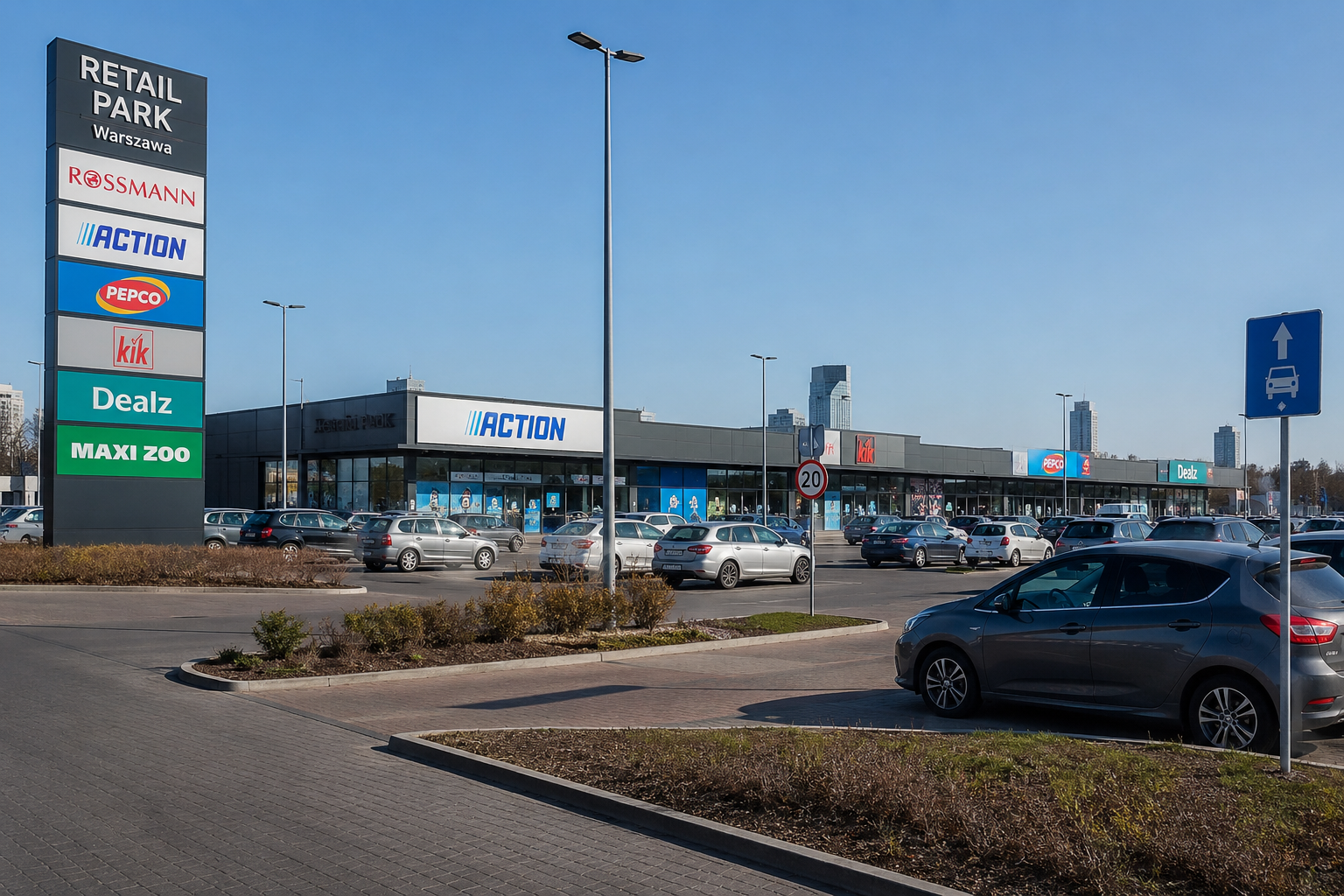
Retail parks are currently the most active development format in Poland.
CBRE reported that six new schemes delivered in Poland in the first quarter of 2026 were all retail parks. Together with eight extensions, they added approximately 79,000 sq m of retail space. (cbre.com)
Colliers reported nearly 70,000 sq m delivered across five new schemes and six extensions during the same period. The difference between the two published figures appears to result from differences in project classification and the number of schemes included by each adviser. This is a useful reminder that market totals should always be read together with the reporting methodology. (Colliers)
Cushman & Wakefield estimated that 73,000 sq m was delivered across five new projects and seven extensions. The firm also reported approximately 770,000 sq m of retail space under construction at the end of the first quarter of 2026, the largest development pipeline recorded in Poland for more than a decade. (Cushman & Wakefield)
BNP Paribas Real Estate placed the pipeline above 780,000 sq m and estimated that retail parks represented 92% of the total space under development. (realestate.bnpparibas.pl)
These figures differ slightly, but the direction is unambiguous: retail parks dominate new retail development in Poland.
The Warsaw market, however, requires a more nuanced interpretation.
Warsaw itself is densely developed and has relatively limited availability of large, appropriately zoned sites. Retail-park opportunities are therefore often located in outer districts or the wider metropolitan area rather than in the central city.
The most relevant investment zones include locations:
Near major residential growth corridors.
Along arterial and ring roads.
Close to suburban municipalities.
In areas with limited existing convenience supply.
Near transport interchanges.
Within or adjacent to established grocery-led catchments.
The Warsaw metropolitan market is particularly suitable for neighbourhood and regional retail parks serving car-based consumers. However, land values, traffic congestion and planning constraints can materially affect viability.
A successful retail park requires more than a large population within a theoretical radius. It needs convenient ingress and egress, adequate parking, strong visibility and a tenant mix matched to local demand.
The format is attractive because it typically offers:
Lower common-area costs than enclosed shopping centres.
Direct access to individual stores.
Efficient customer circulation.
Strong appeal to discount and value retailers.
Relatively simple building structures.
Potentially lower operational complexity.
Retail parks are not immune to risk. Their rapid expansion raises the possibility of local oversupply, especially where several schemes target the same catchment.
The investor should therefore ask whether the location has genuine unmet demand or whether the project is simply following the popularity of the format.
High-Street Retail: Scarcity, Visibility and Uneven Performance
Warsaw’s high-street market remains smaller and less concentrated than the high-street markets of London, Paris, Milan or Prague.
The city’s retail structure has historically been dominated by shopping centres. Large-scale wartime destruction, post-war planning and later commercial development produced an urban environment in which prime retail streets are more fragmented than in many Western European capitals.
Nevertheless, Warsaw has several established high-street zones, including:
Nowy Świat.
Chmielna.
Mokotowska.
Plac Trzech Krzyży.
Marszałkowska.
Selected sections of Świętokrzyska and central mixed-use districts.
Each has a different profile.
Nowy Świat is supported by tourism, gastronomy and pedestrian movement.
Mokotowska and Plac Trzech Krzyży have historically attracted premium and luxury positioning.
Chmielna combines mainstream retail, gastronomy and heavy pedestrian traffic, although its performance varies by section.
Marszałkowska benefits from scale and public transport but does not function as one uniform retail street.
High-street investment offers genuine scarcity. Prime freehold units in central locations are difficult to replicate and may attract brands seeking visibility and prestige.
At the same time, the segment carries several risks:
Irregular unit sizes.
Historic-building constraints.
Limited servicing and delivery access.
Restrictions on signage.
High fit-out costs.
Complex ownership structures.
Variable pedestrian flows.
Dependence on tourism or office workers.
High-street rent should not be assessed using the street name alone. The side of the street, neighbouring tenants, distance from public transport, visibility and width of the frontage can materially affect value.
Two units located several hundred metres apart on the same street may have entirely different leasing prospects.
For investors, high street is therefore a micro-location business. Citywide benchmarks are particularly unreliable in this segment.
Convenience Retail and Grocery-Led Assets
Convenience retail is one of the most defensive parts of the Warsaw market.
The category includes:
Neighbourhood grocery stores.
Pharmacies.
Drugstores.
Bakeries.
Parcel and courier services.
Medical facilities.
Fitness and wellness.
Restaurants and takeaway concepts.
Personal services.
Small convenience centres.
The strength of the format comes from frequency of use. Consumers may reduce discretionary fashion or household spending during weaker economic periods, but they still require food, medicines and basic services.
In Warsaw, convenience demand is supported by:
Dense residential districts.
Large volumes of new housing.
Time-sensitive urban consumers.
Hybrid working.
Growth in local service demand.
Omnichannel fulfilment and parcel collection.
A well-located grocery or pharmacy unit can generate stable footfall for surrounding tenants. This is why grocery anchors play an important role not only in retail parks but also in neighbourhood projects and mixed-use developments.
However, convenience investment is highly sensitive to competition.
A district may have strong demographics but already be served by several supermarkets, discount chains, convenience stores and delivery platforms. The presence of population does not automatically indicate a supply gap.
The investor should analyse:
Existing operators.
Store sizes.
Opening hours.
Parking.
Pedestrian access.
Visibility.
Delivery access.
Planned competing projects.
Tenant sales, where available.
A grocery tenant with a strong brand and long lease can improve investment liquidity. But the investor must still assess the tenant’s actual commitment to the location and the rent’s affordability at store level.
Ground-Floor Retail in Residential Projects
Commercial units in residential developments form one of Warsaw’s most fragmented investment segments.
They are particularly common in districts experiencing rapid housing construction, including parts of Wola, Białołęka, Ursus, Bemowo, Wilanów, Mokotów and Praga.
For private investors, these units are often more accessible than entire retail parks or shopping centres. They may be marketed with attractive headline yields and, in some cases, sold with a tenant already in place.
This apparent simplicity can be misleading.
Ground-floor retail depends heavily on the relationship between the unit and its immediate surroundings.
Critical factors include:
Number of occupied apartments.
Pace of residential completion.
Visibility from public streets.
Pedestrian routes.
Access from the housing estate.
Parking and short-stay stopping.
Ventilation.
Electrical capacity.
Ceiling height.
Delivery access.
Waste storage.
Permitted use.
Restrictions imposed by the residential community.
A new development may contain many commercial units but insufficient early demand to support all of them. This can lead to prolonged vacancy, aggressive rent competition and a concentration of low-margin service uses.
The best units are usually those that serve a clear and recurring local need.
Examples include grocery, medical, pharmacy, childcare, fitness, food service and personal services, provided that technical and planning conditions allow the intended operation.
The weakest units are often located inside estates with poor visibility, limited frontage or no natural pedestrian route.
An investor should never assess such a property solely on price per square metre.
A smaller unit on a prominent corner may be more valuable than a larger unit located away from customer movement.
Mixed-Use Developments
Mixed-use projects are increasingly important in Warsaw.
They combine office, residential, hotel, retail, food and leisure functions within one district or building complex. The model can create strong, diversified footfall throughout the day.
Retail within a successful mixed-use project benefits from several customer groups:
Residents.
Office workers.
Visitors.
Hotel guests.
Tourists.
Transit passengers.
This diversification can improve resilience. A food-and-beverage tenant may serve office customers during the day, residents in the evening and visitors at weekends.
Mixed-use projects also create operational complexity.
The retail offer must be curated rather than simply filled. Too many similar restaurants or service tenants can weaken performance. Delivery, waste, signage and opening-hour requirements may conflict with residential or office functions.
The quality of the master developer and long-term asset management is therefore important.
A retail unit in a mixed-use scheme should not be evaluated only on the building’s architecture or headline tenant names. The investor must understand how the entire district functions after completion.
Standalone Retail and Retail Warehouses
Warsaw and its metropolitan area also contain standalone retail properties such as:
Supermarkets.
Discount stores.
DIY and home-improvement units.
Furniture stores.
Automotive facilities.
Drive-through restaurants.
Specialist retail warehouses.
These assets can provide relatively predictable income where they are leased to strong operators under long-term agreements.
Their investment value depends on:
Tenant covenant.
Lease term.
Indexation.
Ownership of fit-out.
Maintenance obligations.
Planning permissions.
Road access.
Land value.
Alternative-use potential.
A standalone asset may be easier to understand than a multi-let retail park, but it can carry significant concentration risk.
If the tenant leaves, the investor loses all income. Re-letting may require substantial modification, particularly where the building was designed for a specific operator.
The key question is whether the site and building remain attractive without the existing tenant.
A strong lease cannot compensate indefinitely for a weak property.
Omnichannel Retail and the Changing Role of Physical Stores
E-commerce has not removed physical retail from Warsaw’s investment market. It has changed the role of the store.
Many retailers now use stores for:
Customer acquisition.
Brand presentation.
Click-and-collect.
Returns.
Local fulfilment.
Product testing.
Customer service.
The strongest physical locations support the retailer’s wider digital business rather than competing with it.
This favours well-connected, visible and accessible stores. It also increases the importance of logistics, stock handling and efficient collection.
Retail parks and convenience assets are well suited to omnichannel operations because customers can reach them easily by car and collect goods without navigating a large enclosed centre.
Shopping centres remain important for experience, fashion, leisure and brand concentration.
High streets provide visibility and brand identity.
Neighbourhood units offer proximity.
The future of Warsaw retail is therefore not based on one dominant format. It is based on different formats performing different functions within an integrated consumer ecosystem.
What the Market Structure Means for Investors
Warsaw offers a broad range of retail investment products, but diversification of formats should not be confused with uniform quality.
The main conclusions are:
Prime shopping centres remain relevant because of scale, tenant demand and destination value.
Retail parks are the strongest development format nationally, but Warsaw-area projects require careful analysis of competition, access and land economics.
High-street assets offer scarcity but demand highly granular micro-location underwriting.
Convenience retail benefits from recurring expenditure but remains sensitive to local oversupply.
Ground-floor units can provide accessible investment opportunities, but many are structurally weak because of visibility, technical or catchment limitations.
Mixed-use retail can benefit from diversified footfall but depends on long-term place management.
Standalone assets offer income clarity but expose investors to single-tenant concentration.
The most attractive investment is not necessarily the newest building or the longest lease.
It is the asset that combines:
Sustainable occupier demand.
A defensible location.
Affordable rent.
Functional building specification.
Strong lease documentation.
Alternative-use liquidity.
Clear exit demand.
Warsaw’s retail market is deep enough to offer opportunities across several strategies. It is also mature enough to punish weak underwriting.
Sources Used in This Section
JLL — European Retail City Profile: Warsaw https://www.jll.com/en-uk/insights/european-retail-city-profiles/european-retail-city-profile-warsaw
CBRE — Poland Retail Market Figures, Q1 2026 https://www.cbre.com/insights/figures/poland-retail-market-figures-q1-2026
Colliers — Retail Market in Poland, Q1 2026 https://www.colliers.com/en-pl/research/market-insights-rynek-handlowy-q1-2026
Cushman & Wakefield — Poland MarketBeat, Retail Q1 2026 https://www.cushmanwakefield.com/en/poland/insights/poland-marketbeat
BNP Paribas Real Estate — Retail Market in Poland, Q1 2026 https://www.realestate.bnpparibas.pl/en/review-retail-market-poland-q1-2026-0
Colliers — Market Insights 2026 https://www.colliers.com/en-pl/research/market-insights-raport-roczny-2026
CBRE — Poland Real Estate Market Outlook 2026 https://www.cbre.pl/en-gb/insights/figures/poland-real-estate-market-outlook-2026

